‘So, Dad’, I said. ‘You knew Jack. What was he like? What sort of person becomes a hero?’
‘He was mad’, said my father. ‘Jack would come home on leave, get drunk, then run down the beach.’
‘That doesn’t sound crazy.’
‘The beach was mined.’
Ah. So that’s what a hero is like.
. . .
The beach in question was at Sandsend in Northeast England. It was mined in case of German invasion, for this was the middle of the Second World War.
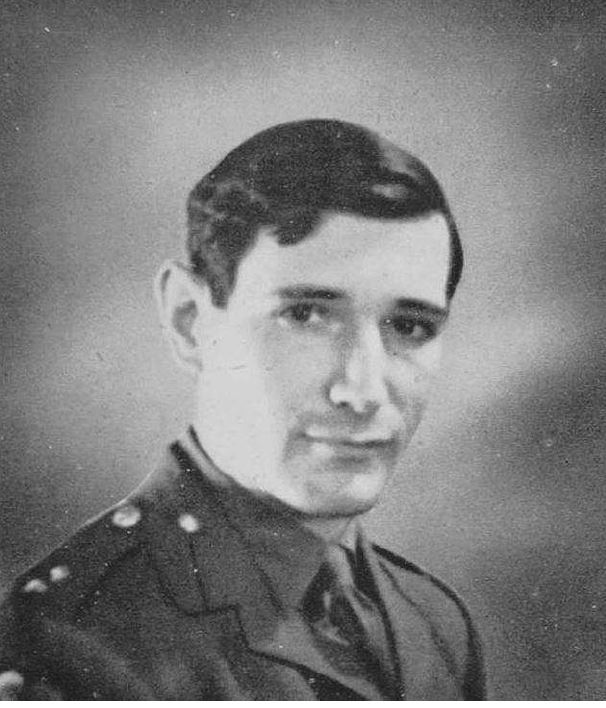
The Jack in question was John ‘Jack’ Grayburn, Lieutenant in the 2nd Battalion of the Parachute Regiment. He was a hero for what he did over four days in September 1944, fighting against impossible odds to hold a bridge in the Netherlands, 62 miles behind enemy lines. By the fourth day, Jack was wounded all over his body. He and the remnants of his platoon (six survived of 35) were defending piles of rubble against enemy tanks. With ammunition low, they now fought with hands, knives and pluck.
Yet Jack still led attacks. Making one more suicidal run across open ground, he was mown down by a machine gun, and died. He was awarded the Victoria Cross.
My father knew Jack because his mother – Little Granny, as we knew her – was adopted by the Grayburns as a child, and he’d grown up alongside this large, kindly family. Seven years younger than Jack, Dad had played beach rugby and gone shrimping with him at Sandsend (before the war, before the mines).
So, Jack was a hero. He was central to my family’s mythology. And I, aged sixty-two, having led a distinctly unheroic life, was off to see where he fell.
. . .
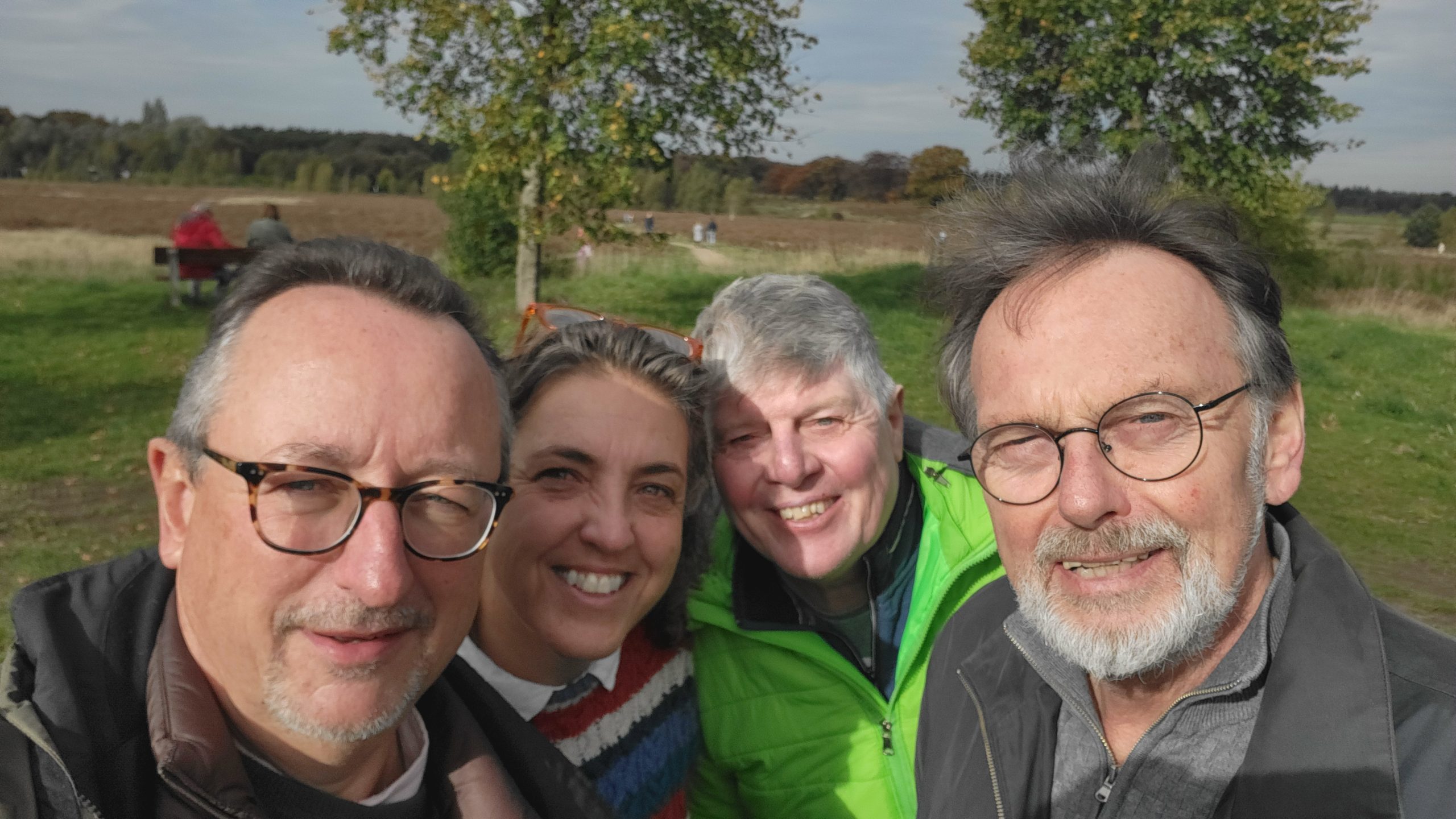
I landed in Düsseldorf to be picked up by my new Dutch friends Frans and Irene. We met last February on a remote island in Indonesia, got on famously, and vowed to meet up in Europe. Now I was arriving to spend the weekend with them in their village of Terborg, half an hour’s drive from Arnhem.
Frans is a proud man of de Achterhoek, a small region beside Arnhem within the Eastern province of Gelderland. It’s a rural area, keen to distinguish itself from the posh urban might of the Western Netherlands. The border with Germany is so porous, we crossed it without noticing, as we journeyed to look at castles and eat raw herrings. And, yes, we cycled a lot, and it was glorious. The land is neat and flat. Whenever we encountered a slight incline, I feigned altitude sickness, as tiresome foreigners tend to do.
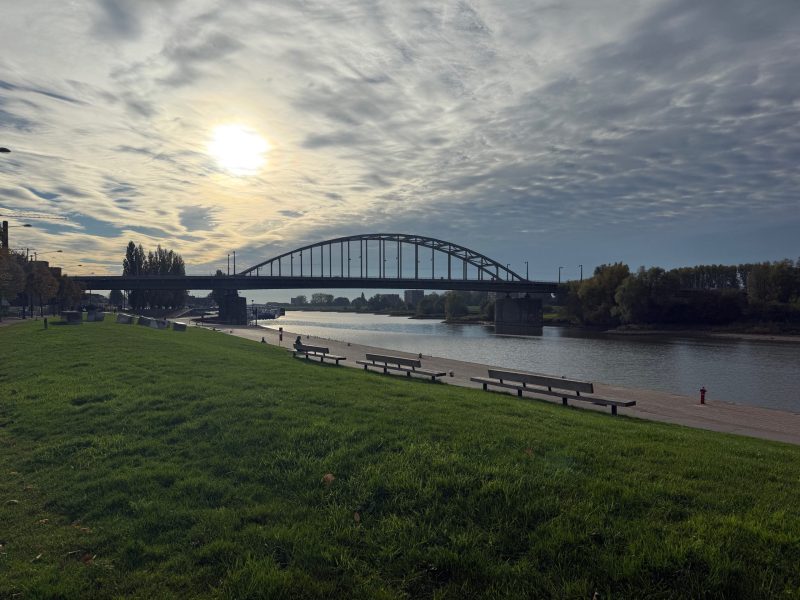
But what of the war? Beyond memories, museums and monuments, there’s little evidence of the terrible fighting there in late 1944/5. The rubble’s been rebuilt. But I’d read much about the battles and learnt the underlying topology. So after Frans parked his van close to Arnhem bridge early on Sunday morning, on my first visit to the battlefield, I got out and realised, with a shudder, we were just yards from where Jack fell.
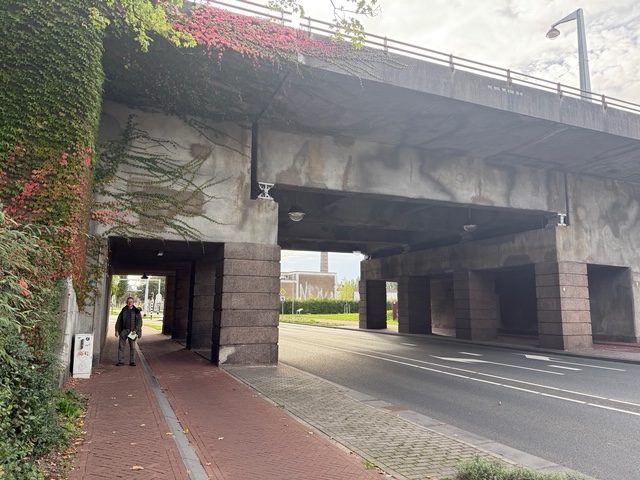
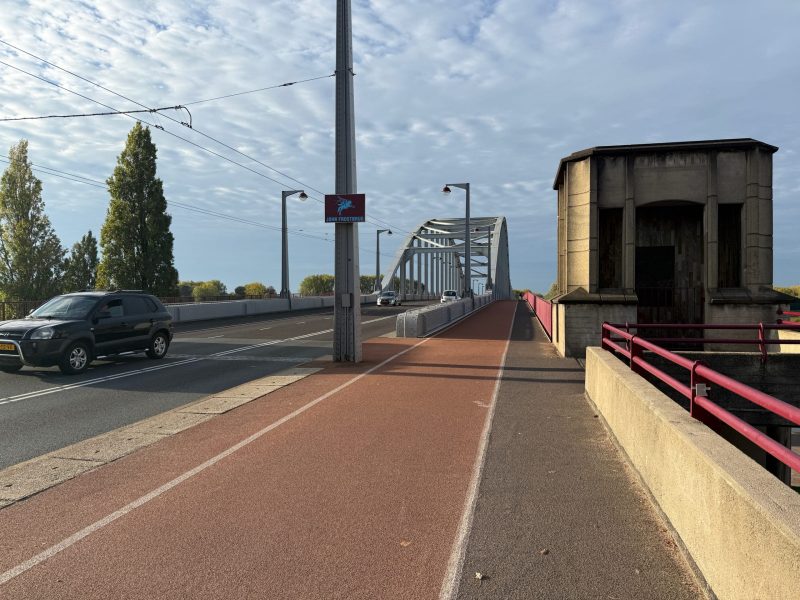
The mighty Arnhem roadbridge still towers over the riverbanks. On the north side, where the battle was fought, it drops into town via a ramp. Smaller roads cut under the bridge, and near one of these underpasses – the bare concrete walls still similar to the original bridge – Jack made his last stand, and his last run.
So here was where Jack fell. I’d expected to build up to this moment during the day. But that first minute I was plunged into the climax of the story. My mood plunged too.
Also yards from the van was the spot where Jack started his four days in Arnhem, laying an ambush on the embankment beside the off-ramp from the bridge. Many German soldiers died upon that stretch of tarmac. And many paratroopers died, when Jack led an attack on a pillbox defending the bridge. Its machine gun gave Jack his first wound, in the shoulder.
We walked over the bridge, further than the allied soldiers ever managed, and back. Then we walked westwards beside the river. There’s a fine small museum in sight of the bridge, which tells the story of three people: an English soldier, a German soldier and a Dutch resistance fighter. The English soldier featured is Jack Grayburn.
Blimey. Trust me to pick a celebrity subject for my battlefield tour. Just mentioning Jack’s name spurred a powerful response wherever we went. I took care to stress he wasn’t a blood relative, but there was a strong family link.
The Dutch are wonderful custodians of these sites of slaughter. Though the Arnhem campaign brought horror into their homeland, after relatively peaceful years of occupation, they always honour those young men who landed in their midst, then died in their houses. The museums are moving and well-funded. The cemeteries are beautiful. And everyone I met took pains to enquire, listen and remember.
Private Steve Morgan, who fought alongside Jack – and survived – later said: ‘We came here to liberate them, but we smashed their city up. It makes me wonder how they can forgive us, but they always have.’
. . .
Frans, Irene and I drove a few miles west to Doorwerth, where we took coffee with Peter van den Hout and his wife Carole at their lovely house in the woods. Peter had kindly offered to take us round the sites of fighting to the West of the city. For while Jack and his pals were struggling by the bridge, several thousand of their comrades were similarly encircled seven miles away, unable to reach them.
They’d all landed together on heathland locations around Wolfheze and Renkum. Which is famously one of the Dubious Decisions (DD) that doomed this campaign. Paratroopers need to land close to what they wish to grab. Dropping them seven miles away from the bridge removed all surprise, especially since one of the campaign’s Unlucky Breaks (UB) was that two tough German Panzer divisions were already in the area (which was also a DD as their presence had been reported beforehand by Dutch resistance.)
After landing on Sunday afternoon, Jack and some seven hundred soldiers fought their way through by the river to reach the bridge. Their colleagues headed for the bridge by other routes, just streets away, but never made it through, and were trapped by the Germans in a circle around Oosterbeek. The Allied radios often didn’t work (both UB and DD) so everyone was fighting blind, with no news of the relief column trying to punch north through Eindhoven and Nijmegen.
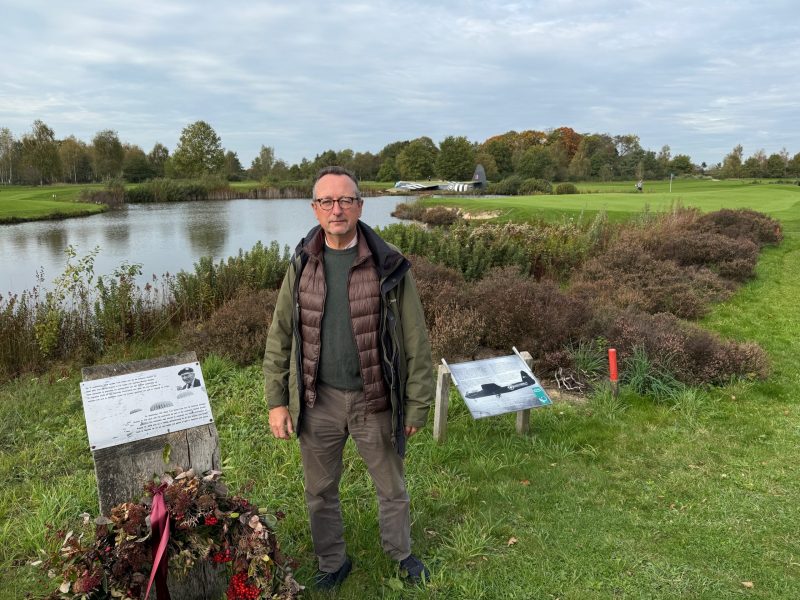
Peter took us to the golf club at Heelsum, where we felt like interlopers among the smart cars and buggies. ‘It’s a good place for afternoon wine and Bitterballen’, said Peter. But deep-fried meatballs were not then on our agenda. The golf club is set where many of the Allied gliders landed. You can see one of them today, perched behind the Ninth Green, only a replica but still startling. These flimsy craft flew through flak to land jeeps, small guns, and other soldiers – the stuff that didn’t arrive by parachute.
Unlike the pilots dropping parachutists, the glider pilots couldn’t go home. They had to stay and fight, but most were commando-trained. Of the 1,354 glider pilots who took part 229 were killed and more than 500 taken prisoner.
Peter led us North to the landing site on the heathland around Ginkel. It’s just like the scene from A Bridge Too Far, the 1977 epic movie which – for many of us – not only introduced the story, but also stamped it visually in our minds. Standing in a layby, I could easily imagine clouds of parachutists hit the ground before me, free themselves from the silken webs that let them float, then rush towards the bugles calling them to gather.
Back on the road, we soon reached the centre of this battle – Oosterbeek. It was time for lunch so, of course, we went into the Restaurant Schoonoord – the ‘Airborne Pub No 1’ – which served as a medical dressing station in the midst of the fighting. For some reason, I felt the need to lighten the mood. So heroically I asked Peter, Irene and Frans, ‘would you like to hear a funny story about the treatment of Jews in the Netherlands during the war?’
They looked at me suspiciously. So I told them the old, old story – which is NOT TRUE – of the American actress Pia Zadora, famously wooden on stage, playing the title role in a Broadway production of The Diary of Anne Frank. Her performance was so dreadful that when the Nazi stormtroopers marched on stage looking for her, someone in the audience shouted, ‘She’s in the attic!’
I’m delighted to say this UNTRUE anecdote worked its magic. Hilarity ensued. Not that my chums needed cheering up. Thrown together to explore Jack’s journey, we were a convivial bunch, bound by warmth amongst the poignancy.
. . .
Lunch over, it was time to visit the Airborne Museum Hartenstein, set in the old hotel that became Allied HQ during the battle. It’s a wonderful museum. You walk around the actual building where fighting took place. It’s been restored beautifully. Then you go down, underground, to enter the battle itself, walking through what seem like film sets which, with debris, lighting, and shattering sounds, make you think you’re actually fighting a street battle or defending a foxhole. None of us said a word as we progressed through this hellscape.
‘Better than Fort Duurstede,’ said Irene afterwards. We’d together visited this old Dutch fort on Saparua in the Spice Islands, where a tired, dusty diorama did scant justice to Indonesian national hero Pattimura. Hartenstein was different. It was theatre. It was education, maybe even spiritual. It moved us greatly.
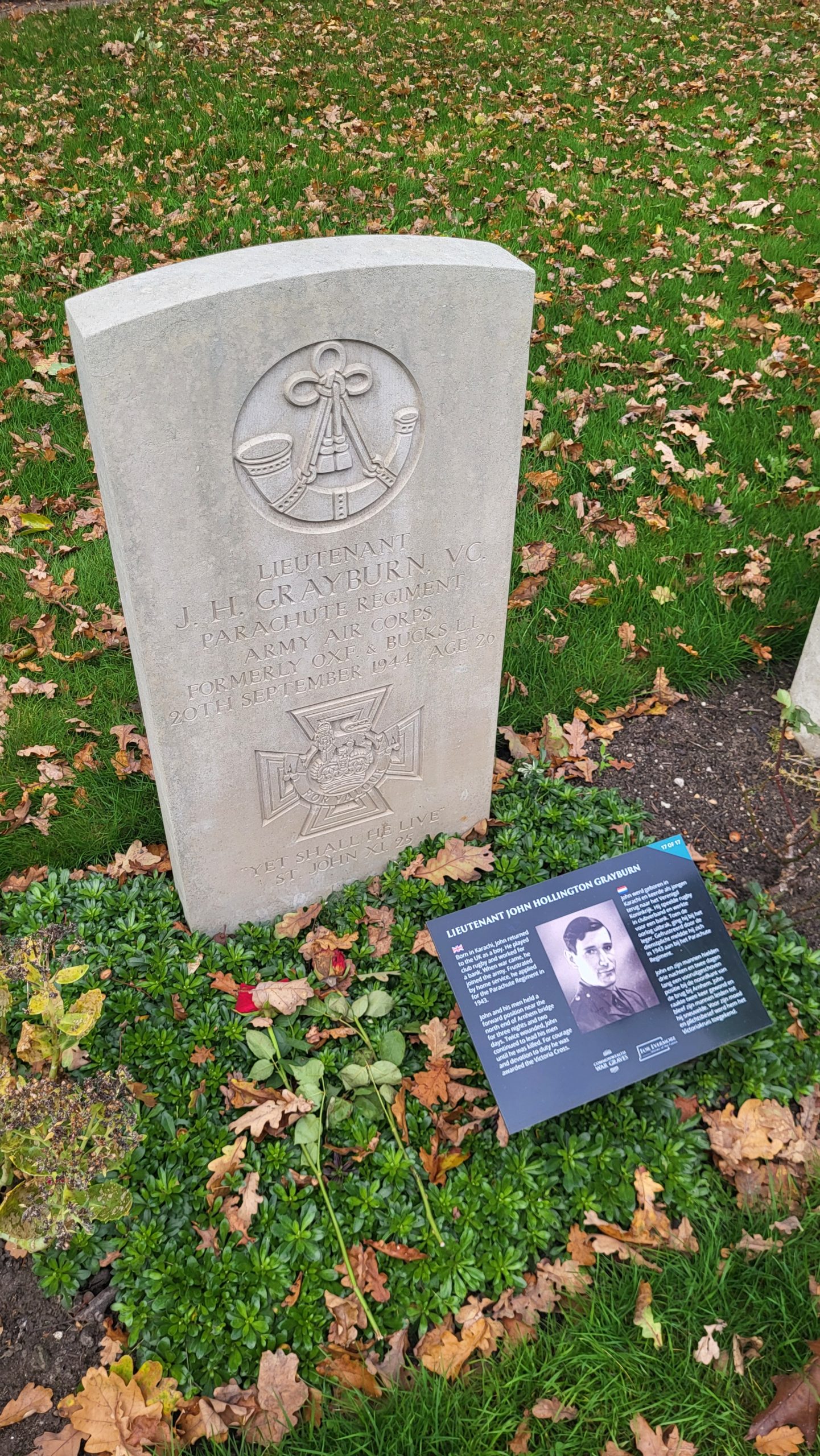
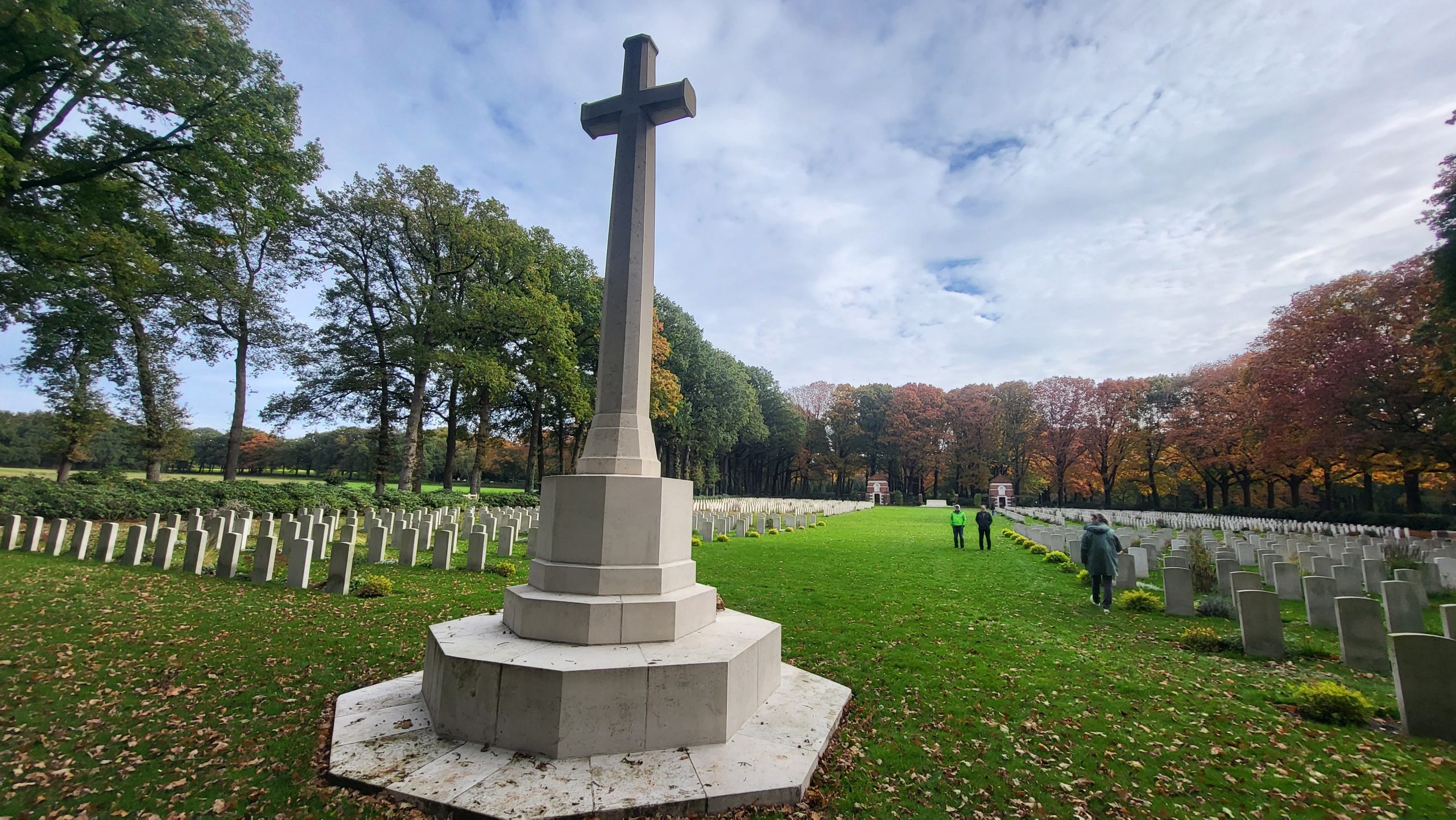
Now, finally, the time had come to visit Jack’s grave. He’s buried among 1,764 Allied dead at the Airborne Oosterbeek War Cemetery. Here we wandered the immaculate lines of gravestones, scanning the ages of the dead. Few were older than Jack, then 26. He’s at the far end, facing his comrades. Someone had lain some red roses beside his grave.
There are two carvings on Jack’s gravestone. One shows the Victoria Cross, Britain’s highest military honour, the other shows a bugle. This is the cap badge of the British Light Infantry, so its inclusion signifies Jack’s former service with the Oxford and Bucks Regiment. It also honours an unusual feature of the battle.
Jack’s 35-strong platoon was one of three platoons in A Company, 2nd Para Battalion. His company commander was Major Digby Tatham-Warter, who’d trained his 110 troops in the use of Napoleonic bugle calls in case of radio failure. This proved unexpectedly useful in the fighting at Arnhem, where the radios did fail, and soldiers were often trapped in buildings unable to see or hear each other. Bugle calls cut through the noise of fighting. They baffled the enemy.
This was a detail I’d gleaned from reading about the battle before the trip. There were hundreds of books to choose from. British historians love heroic failure. But I’d had to ration my reading, not through lack of time, or information overload, but due to the sheer horror of the story.
I’d learnt that paratroopers are the most aggressive of soldiers. Dropped into the heart of enemy territory, without support or heavy guns, they must kill or be killed. They’re trained to do so by knife or hand. Though the battle at Arnhem was often punctuated by gentility – as both sides honoured truces to remove wounded – the fighting itself was vicious.
When I was a child, I devoured war films like A Bridge Too Far. They were like cartoons. Now I have trouble watching them. Each death hurts. So, too, with the detailed accounts of the fighting. I found it helpful to be selective in what I consumed. In that spirit, I now include a first-hand account of Jack’s death, written by a soldier fighting alongside him.
On the fourth day of struggle at the bridge, Private Steve Morgan found himself among a small group of soldiers, led by Jack, taking shelter in an underpass beneath the bridge. I’ll let him tell the story.
Lt Grayburn was already wounded in several places. I remember seeing a bandage round his head, his right arm was in a sling and he was firing his pistol with his left hand. One of his trouser legs was ripped, and his leg was bandaged as well.
As we were surrounded by Germans firing their rifles, we were being picked off one by one until just Lt Grayburn and myself were on our own. All the soldiers around us were either dead or too wounded to take part. He patted me on the back and said something like, ‘It’s time to go’.
We ran out from under the bridge in a zig-zag formation firing our weapons and it was at this point that I finally ran out of ammunition, having used all 400 rounds. I reached cover, but before Lt Grayburn could join me, the tank in front fired – and he fell. I looked out and saw him lying on the road.
I realised he was still alive and called to him. I also remember somebody, who sounded like an Officer, shout from a nearby building, something like, ‘Is it very bad?’ He replied, ‘Leave me’. He knew he was dying. The Officer replied, ‘Goodbye dear boy’. I remember somebody who also sounded like an Officer call out, ‘Good Luck’.
I decided to try and pull him under cover, and crawled out on my front. It was quite odd because the Germans did not fire at me. Lt Grayburn again said, ‘Leave me.’ Unfortunately he was too heavy for me to move on my own, and I had no choice but to get back under cover. He was aged 26 and was posthumously awarded the Victoria Cross. He was a very brave man and somebody whom I admired very much.
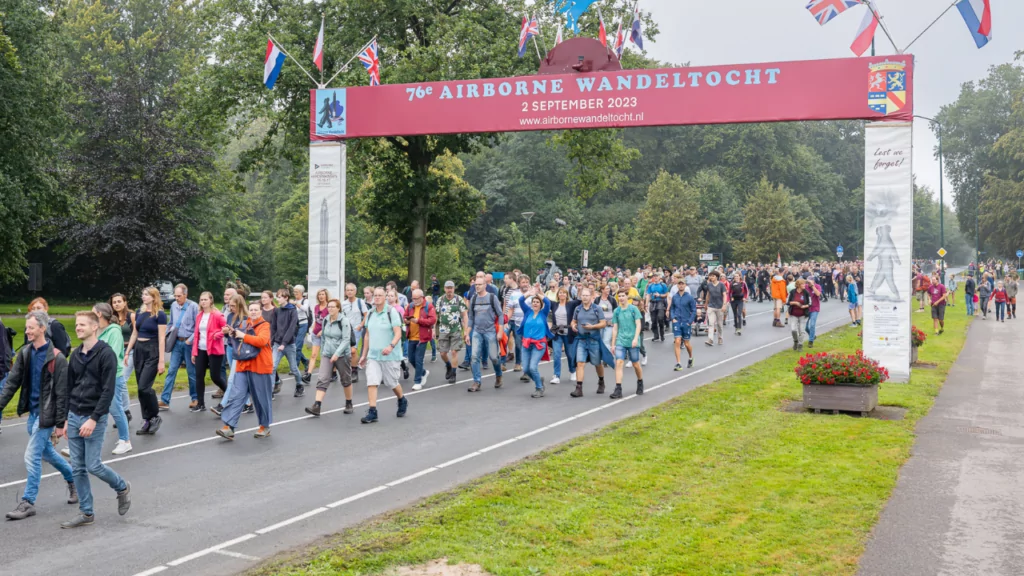
Autumn leaves were gently falling as we left the cemetery at Oosterbeek. We dropped off Peter at his house in the woods, then Frans, Irene and I drove back to Terborg. I’m so glad to have been with them while exploring where Jack fought and fell. The first commemoration of the battle took place in 1945. A thousand school children laid flowers on the graves. At the 25th commemoration, in 1969, the Parachute Regiment thanked the Dutch authorities and said it would be fine to end the annual ceremony as the battle had passed sufficiently into history. The Dutch vehemently refused. This year, a record 36,000 participants (including Frans) joined the 10-40km Airborne March. It’s the largest such event in the world.
Walking is a good way to honour sacrifice. It’s a quiet statement that requires effort. It enables you to stand side by side with others, sometimes to talk, sometimes to reflect and, yes, sometimes to laugh. (When posing beside memorials for serious photos, I occasionally could not help flicking out my thumbs with a big smile, like a tourist shot for instagram. Frans ignored such cartoon disrespect.)
The annual march in September, just like the October day I spent with my Dutch pals, is a chance to spend time immersed within an important story. I strongly recommend hunting out some similar story within your own family or community.
© Matthew Crampton 2025. Photos by Frans Miggelbrink and Matthew Crampton.
Links: Private Steve Morgan’s story, more about Jack at Wikipedia, the Airborne March.